

01 / OVERVIEW
One hackathon scene, four kinds of material
A good 3D scene is not always built from one type of asset. Sometimes it starts with a real place. Sometimes it needs an imagined extension. Sometimes it only becomes meaningful when characters enter the space and give the viewer a reason to care. (Special thanks to the project owner, Spatial Dreamer.)
That is what makes this hackathon project interesting. The participant did not simply use PortalCam, Marble, and Tripo as separate tools in a production pipeline. He used them as different ways of bringing a story world into view: PortalCam captured the texture and specificity of a real commercial district in Santa Barbara; Marble helped extend that captured world with an AI-generated beach environment; Tripo brought in mesh-based character assets, placing a couple inside the scene and turning the environment from a spatial demo into something closer to a narrative moment.
The participant also made a practical engineering choice: after scanning the space as 3DGS, they placed virtual cameras inside the scene, rendered images from those viewpoints, and used those images to reconstruct a lower-poly mesh version of the environment. That mesh version helped the full project run more comfortably on lower-spec computers and integrate with other mesh assets.
The result is not just a combination of Gaussian Splatting, mesh reconstruction, and AI generation. It is a small but clear example of where spatial creation is heading: toward workflows where the asset format is not the story. The story is what those assets make possible.
02 / OVERVIEW
Starting from a real place
The project begins with PortalCam scanning a commercial area in Santa Barbara. This matters because reality capture gives a scene something that is difficult to invent from scratch: the irregularity of the real world. Storefronts, streets, signage, scale, spatial relationships, and small environmental details all carry the feeling of a specific place.
For a creator, that kind of grounding is valuable. It gives the scene an immediate sense of location. The viewer is not looking at a generic city block. They are looking at a space that feels lived in, walked through, and physically present.
In the XGRIDS workflow, PortalCam provides the captured spatial data, which can then be processed into a high-quality 3D Gaussian Splatting scene. This gives creators a fast way to bring real-world environments into digital production without rebuilding every surface by hand. But a captured place is still only one part of a story.
“In this project, Gaussian Splatting and mesh generation were not the story. They were the materials used to make the story believable.”
03 / OVERVIEW
Extending reality with GenAI
The participant did not stop at the scanned commercial district. They used Marble to generate a beach environment and combined it with the captured scene to create a more complete world. This is where the project becomes more than a reality capture demo.
A real scan provides authenticity, but it is bound by what was physically present during capture. GenAI can help fill the parts of the world that the story needs but the camera did not capture. In this case, the beach becomes an extension of the Santa Barbara setting, adding a different emotional and visual layer to the scene.
The important point is not that one part is real and the other is generated. The point is that each part has a role. The PortalCam scan anchors the world. The Marble-generated beach expands it. Together, they create a broader environment than either asset could provide alone.
04 / OVERVIEW
Turning a captured splat into a lightweight mesh
Spatial Dreamer also made an important technical decision after capturing the Santa Barbara scene. Instead of using the original 3DGS scene directly throughout the whole project, he placed virtual cameras inside the splat scene and rendered images from those viewpoints. Those rendered images were then used to reconstruct a lower-poly mesh version of the environment.
This was not because the Gaussian Splatting scene had no value. Quite the opposite: the splat provided the high-quality spatial source. But for this specific hackathon project, the participant wanted the final scene to run more easily on lower-spec computers and to integrate naturally with other mesh-based assets, including the Tripo-generated couple characters.
In that sense, the workflow became a practical bridge: capture reality as a high-fidelity 3DGS scene, use virtual camera renders to derive a lighter mesh representation, and then compose that mesh environment with generated characters and additional scene elements. It is a useful reminder that 3DGS and mesh are not competing ideas in every workflow: sometimes the splat is the best way to capture and preserve the real place, and sometimes mesh is the best way to package the experience for a particular runtime, device, or interaction model.
05 / OVERVIEW
Bringing Tripo-generated characters into the scene
A place becomes more readable when someone is there. By using Tripo to generate mesh-based couple characters, the participant added a human presence to the scene. The characters do not need to be the technical centerpiece. Their value is narrative: they give the viewer a focal point and suggest that something is happening inside the environment.
This changes how the scene is perceived. Without characters, the result may feel like a spatial showcase. With characters, the same environment begins to feel like a setting. The viewer can imagine a walk, a meeting, a memory, or a moment between two people.
That is a subtle but important shift. The technology is still visible, but it is no longer the only thing the viewer sees.
06 / OVERVIEW
When keeping the splat is the better choice
Converting a Gaussian Splatting scene into mesh is not always necessary. If the goal is to view, explore, or publish a high-quality 3DGS scene, teams can keep the scene in its native splat format and use the XGRIDS Web SDK for online viewing. The Web SDK supports LOD control, allowing the experience to adapt across different devices, including mobile phones.
During browsing, streaming LOD can progressively load the right level of detail based on the viewer's position and device capability. This makes it possible to explore tens-of-millions-scale Gaussian scenes smoothly, even on phones, without forcing the entire dataset to behave like a traditional mesh project.
That makes the choice workflow-dependent. For direct 3DGS browsing, keeping the splat can preserve visual fidelity and take advantage of XGRIDS’ streaming and LOD capabilities. For a lower-spec interactive project that needs to combine a captured environment with mesh characters and other generated assets, converting parts of the scene into a lightweight mesh can be a practical production decision. The key is not to treat one representation as universally better. The key is to choose the representation that best serves the story, the device, and the experience.
07 / OVERVIEW
Materials, not the story: what this means for spatial creation
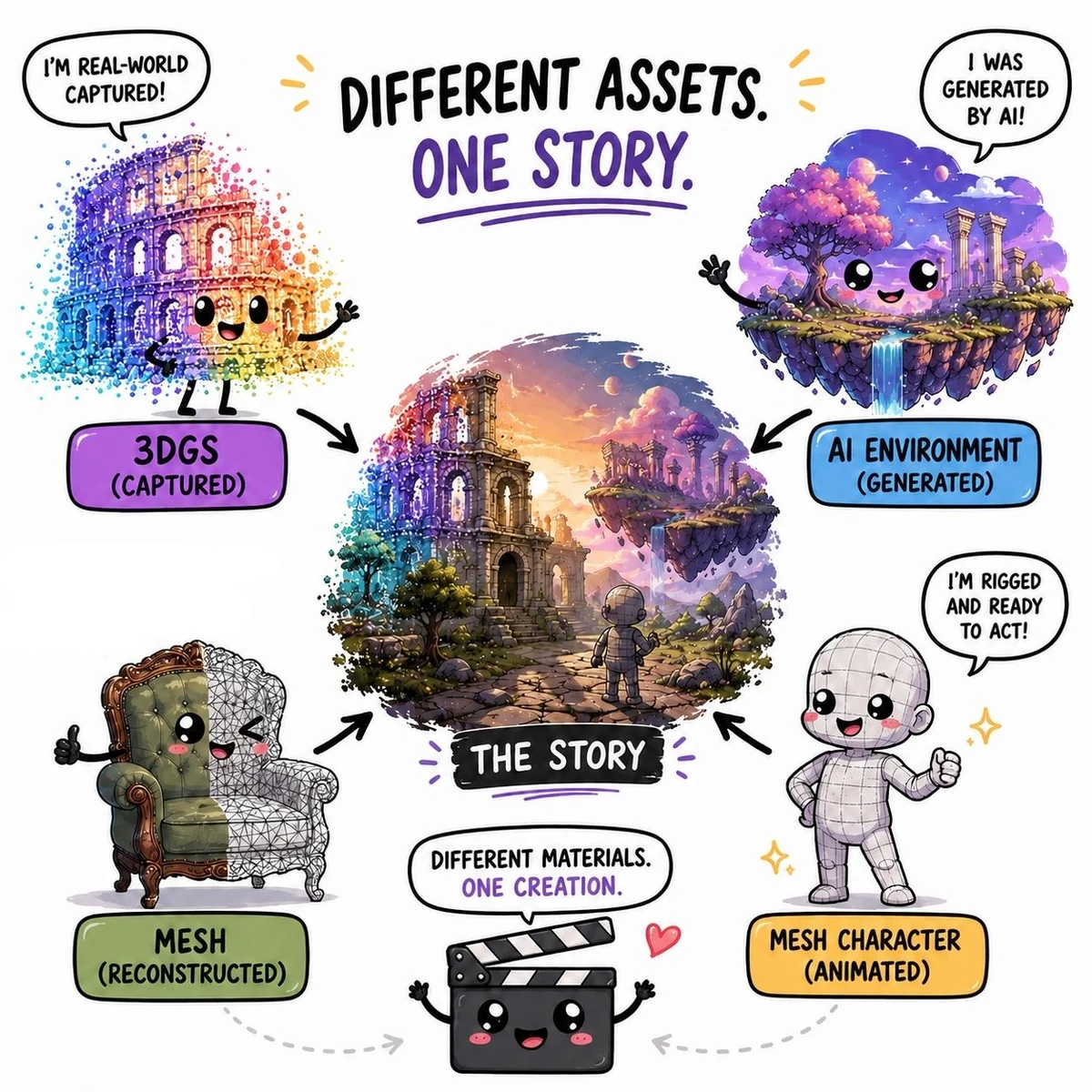
This project combines different asset types: captured 3DGS, an AI-generated environment, reconstructed mesh, and mesh characters. From a technical perspective, those formats are different — they may have different rendering requirements, editing behaviors, performance profiles, and production constraints. But for creative workflows, the most interesting question is not always whether every asset comes from the same representation. The better question is: can these assets work together to make the scene more believable, more expressive, or more useful for storytelling? In this hackathon project, the answer is yes. PortalCam, Marble, and Tripo each contribute something different, and the final scene works because those contributions serve a shared creative purpose.
Reality capture and GenAI are often discussed as separate directions. Reality capture is associated with accuracy, reconstruction, and the faithful digitization of real places. GenAI is associated with speed, imagination, and the ability to create what was not captured. This project shows why the two are more powerful when they are used together: reality capture gives creators a trusted foundation, GenAI gives them room to extend that foundation, character generation gives the scene a human layer, and mesh reconstruction gives the project a practical runtime path when lower-spec devices need to be considered.
The workflow becomes less about choosing between real and generated content, or between splat and mesh, and more about deciding what each method is best suited to express. For creators, this is especially important. They often need to move quickly from idea to prototype, and a workflow that combines captured spaces, generated environments, generated characters, and device-aware optimization can help them build story-ready scenes without starting from a blank canvas.
08 / OVERVIEW
Technical boundary and closing thought
A technical boundary worth stating clearly: in this project, PortalCam is used for reality capture, Marble is used to extend the world with AI-generated spatial content, Tripo is used to create mesh-based character assets, and the 3DGS-to-mesh step is a runtime-oriented production choice. These are complementary methods, not a claim that every asset has the same data structure, fidelity, or editing behavior. The Marble-generated beach should be understood as AI-created spatial content, not as part of the original Santa Barbara scan; the Tripo characters are different from the splat-based source environment and may follow different rules for rendering, editing, animation, or integration; and the low-poly mesh reconstruction step serves this specific project’s needs — it does not mean every 3DGS scene needs to be converted to mesh. For many viewing and publishing scenarios, the XGRIDS Web SDK provides a more direct path with LOD and streaming support.
The most interesting part of this project is not that it used 3DGS, generated environments, reconstructed mesh, or mesh characters. Those are the materials. The story comes from how they are used together: a real street gives the scene authenticity, a generated beach gives it expansion, a pair of characters gives it presence, and a lightweight mesh version gives the project a practical way to run as a complete experience.
In combination, reality capture and GenAI become more than production shortcuts. They become ways to build a world where a story can happen. In this project, Gaussian Splatting and mesh generation were not the story. They were the materials used to make the story believable.
SOURCE / XGRIDS
From a Real Street to a Story World
This article is an original editorial adaptation of the original piece from XGRIDS.