

 Try it live
Description
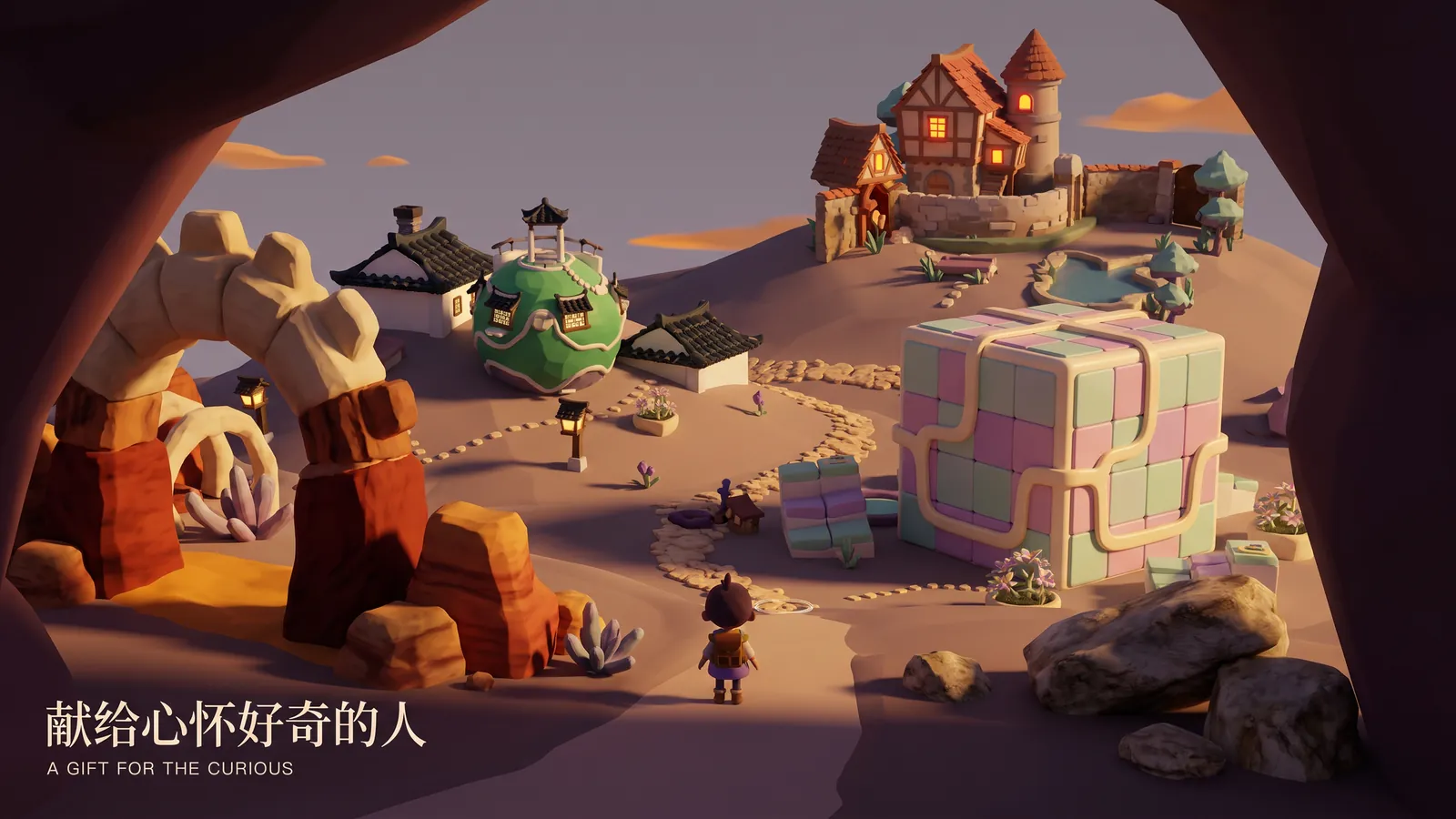
A Gift for the Curious is a set of four games tied together by curiosity. The team created four worlds that unfold from whimsy: a surreal land you can keep venturing deeper into, a town that stretches around a sphere, a cube garden where you climb over edges and rethink direction, and a fairy-tale village that grows at your fingertips. Here, space itself is a playground for the imagination: the distance invites you to explore, corners hide puzzles, and empty ground waits for you to give it a new shape.
You can feel the unknown as you run and adventure, find the delight of a solved puzzle through observation and trial, or slow down and build a little world of your own with a single drag, a stretch of wall or a roof. The team hopes the experience brings both the thrill of discovery and the ease of creation, so that curiosity always gets an answer and everyone leaves with a world they would gladly return to.
It is a gift for everyone who still asks "what if?" The games use Unity, Godot and Three.js, and the collection itself is a Three.js scene whose models are assembled by layout rules at runtime.
How Tripo was used
Tripo turns concept designs into 3D assets that code can call directly, and it is the core production step for the collection's 3D visuals.
- Workflow: Nano Banana reference images, Tripo P2 image-to-3D, topology work and multi-view checks in Blender, and scene-generation and interaction systems written with Codex. In the end, 31 model types became reusable scene modules.
- Runtime model library: the Tripo P2 models are organized into a runtime library, and code uses each asset's ID, size, bounding box and material data to scale, duplicate, place and combine it automatically, building four distinct sets of scenes from one shared asset set.
- Procedural assembly: in the collection, Three.js assembles models by layout rules at runtime, sampling terrain height and normals so buildings and plants sit on slopes, interpolating stones along paths, using a fixed random seed to control flower and grass density, and batch-rendering repeated models with GPU instancing. Tripo-generated terrain is also shaped procedurally at the vertex level into continuous rolling ground.
- Generated in parts: the complex spherical town was generated as separate pieces (the sphere, houses and towers) and assembled in code.