


Description
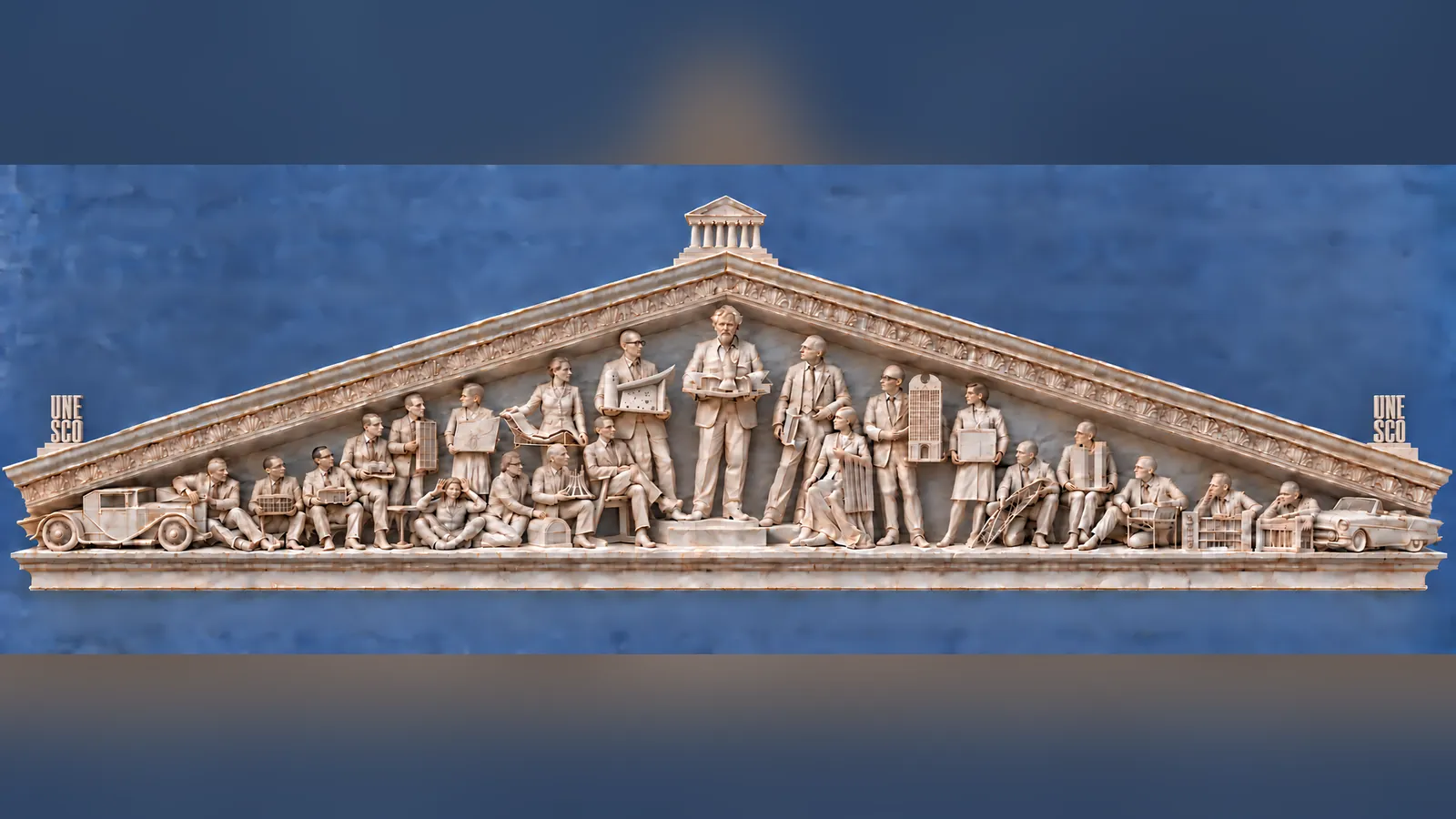
Pediment of Modernism reimagines the composition of the Parthenon's east pediment as a sculptural account of modern architecture. It treats the ancient pediment not as a decorative backdrop but as a rigorous spatial system, whose twenty-two sculptural positions can hold a new historical narrative.
Two architectural lineages approach one another beneath the triangular frame: the left wing develops from Le Corbusier, the right follows Mies van der Rohe. At the apex, an elderly Frank Gehry holds the Guggenheim Museum Bilbao, representing neither victory nor divinity, but the unstable point at which those competing traditions are inherited, challenged and transformed.
Every architect appears in a recognizable mature form, in historically appropriate modern clothing, with one restrained identifying attribute. Le Corbusier holds Notre-Dame du Haut at Ronchamp; Walter Gropius is paired with the Bauhaus façade and its vertical lettering; Philip Johnson carries 550 Madison Avenue. Eileen Gray appears close to Le Corbusier with her E-1027 table, making a mischievous gesture that quietly challenges the conventional authorship and hierarchy of the modernist canon. At the outer corners, the horses of the ancient composition become twentieth-century vehicles, Le Corbusier's Voisin C7 and Mies's 1954 Oldsmobile 88 Convertible: modern chariots that keep the outward movement and low silhouette of the original.
Rendered throughout in warm white marble, the piece unifies people, buildings, furniture, machines and contested histories in a single material language. It is designed as an inspectable digital sculpture, with a future path toward modular fabrication and installation. It was first conceived for AIA New York's Figures of Architecture; because AI-generated imagery is ineligible there, the author submitted it hors concours, as a transparent contribution to the discussion. The orthographic views were created in ChatGPT, and Blender was also part of the process.
This world is offered as a gift to AIA New York | Center for Architecture, and to students, architects and the public: an architectural family portrait that makes inherited lineages visible while leaving them open to criticism, humor and renewed interpretation.
How Tripo was used
The author brought the piece to Tripothon to move it forward with Tripo: Tripo's image-to-3D, multiview, segmentation and retopology tools can turn the concept into editable geometry and a path toward physical fabrication. For the author, AI here is an iterative design tool rather than concealed authorship.