

Description
Reverie lets anyone collect the moments they cherish, from life or from fiction, inside a musical world they can explore by hand. A shared trip, a favorite anime character, a view in a game or a moment from a novel can inspire a personal gift, for someone who shares that memory or story, or for yourself.
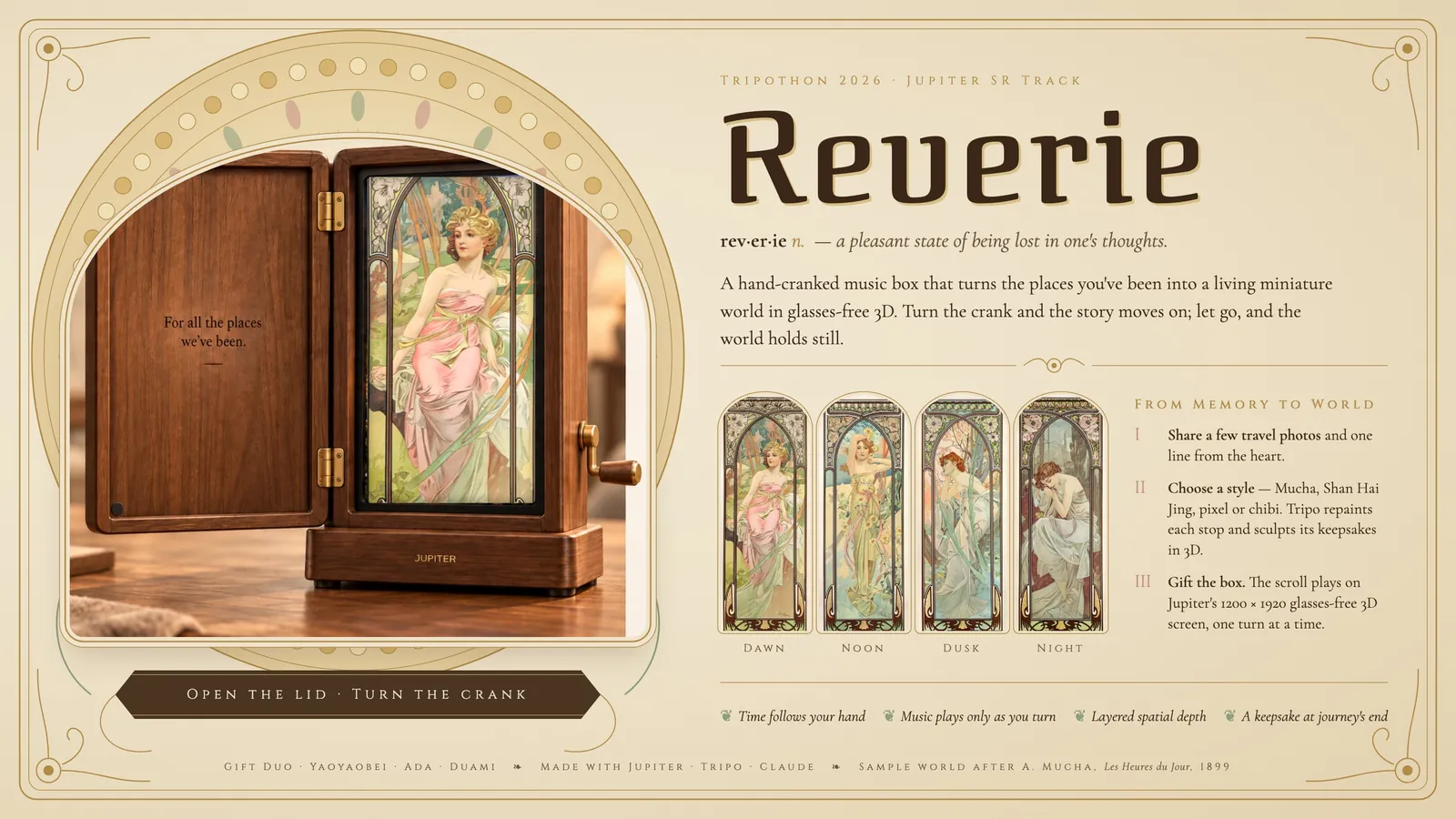
Turn the crank and a horizontal world unfolds to music: you travel through familiar places and meet beloved characters and objects, and at the end a keepsake in the scene gives the journey a personal conclusion. At the heart of the object is a Jupiter glasses-free 3D light-field frame. The team stands the frame upright so the lenticular columns keep the left-right parallax, and the box is scaled from real-world millimeters (192 × 324 mm outside), so the scroll on screen matches the proportions of the physical music box. The crank uses a Pro Micro acting as a USB keyboard, wired to the frame's mainboard: each full turn moves the world forward a stretch, and the music moves along with it.
The team's proposed creation flow starts with photos, reference images and the user's ideas. The system interprets them and creates an editable 2D panorama, and users refine its theme, composition and elements, choosing a world such as a Mucha garden, a Shanhaijing fantasy, a Bauhaus playground, a pixel island or a chibi miniature. Once the 2D design is confirmed, the Tripo API generates individual 3D elements; a language model helps arrange the scene, or users adjust position, scale and depth themselves. After confirming the world and choosing music, the scene, music and final keepsake are packaged and uploaded to the Jupiter hardware, to be explored with the hand-cranked music box.
Instead of the Unity plugin, the team wired the web interlacing output of the Jupiter Interlace SDK straight into a Three.js scene: the same web code is a 2D preview on a computer and glasses-free 3D on the frame. Each stop's panorama concept is turned into an explorable 3D world with World Labs Marble to check whether the foreground, midground, background and far distance truly separate; it is then pre-rendered into a backdrop plate behind the Tripo-generated foreground models, giving real depth at the back while keeping the front interactive and the performance under control.
The piece is for people who share memories and stories. The team hopes it lets anyone shape a world around what moves them, then see it, hear it and revisit it at their own pace.
How Tripo was used
Tripo produces every 3D asset in the piece: once the 2D design is confirmed, the Tripo API generates each 3D element. In the team's words, it replaces weeks of manual modeling, so anyone can build their own 3D world on a web page in minutes.
- Style images: after a user uploads photos, Tripo redraws them in the chosen art style, such as Mucha.
- Characters: turned into 3D models through multiview generation, then pressed into reliefs by the team's own scripts to suit the light-field display.
- Objects: generated directly with image-to-3D; small pieces are voxel-rebuilt, decimated and baked so they render smoothly on an RK3566.
- The demo case was actually generated with Tripo: 3 photos, 12 style images, 4 reference images and 4 models, with World Labs backdrop plates pre-rendered behind the foreground models.