

Description
Upright Planet grew out of a true story. In the summer of 2021, China's National Health Commission and Ministry of Education revised the health examination rules for primary and secondary school students, making spinal checks a basic exam item for the first time. That year, the author's team joined a larger joint team in a county in Shaanxi for the last large-scale field test before the standard was released: 36 depth cameras built a model of each student's back in 5 seconds for initial screening, with a screening success rate above 95%, but the cost of the hardware kept it from scaling. Five years later, now a father, the author turned that regret into this planet: one phone photo plus Tripo's 3D capabilities, meant to give every family a free, gentle first screening.
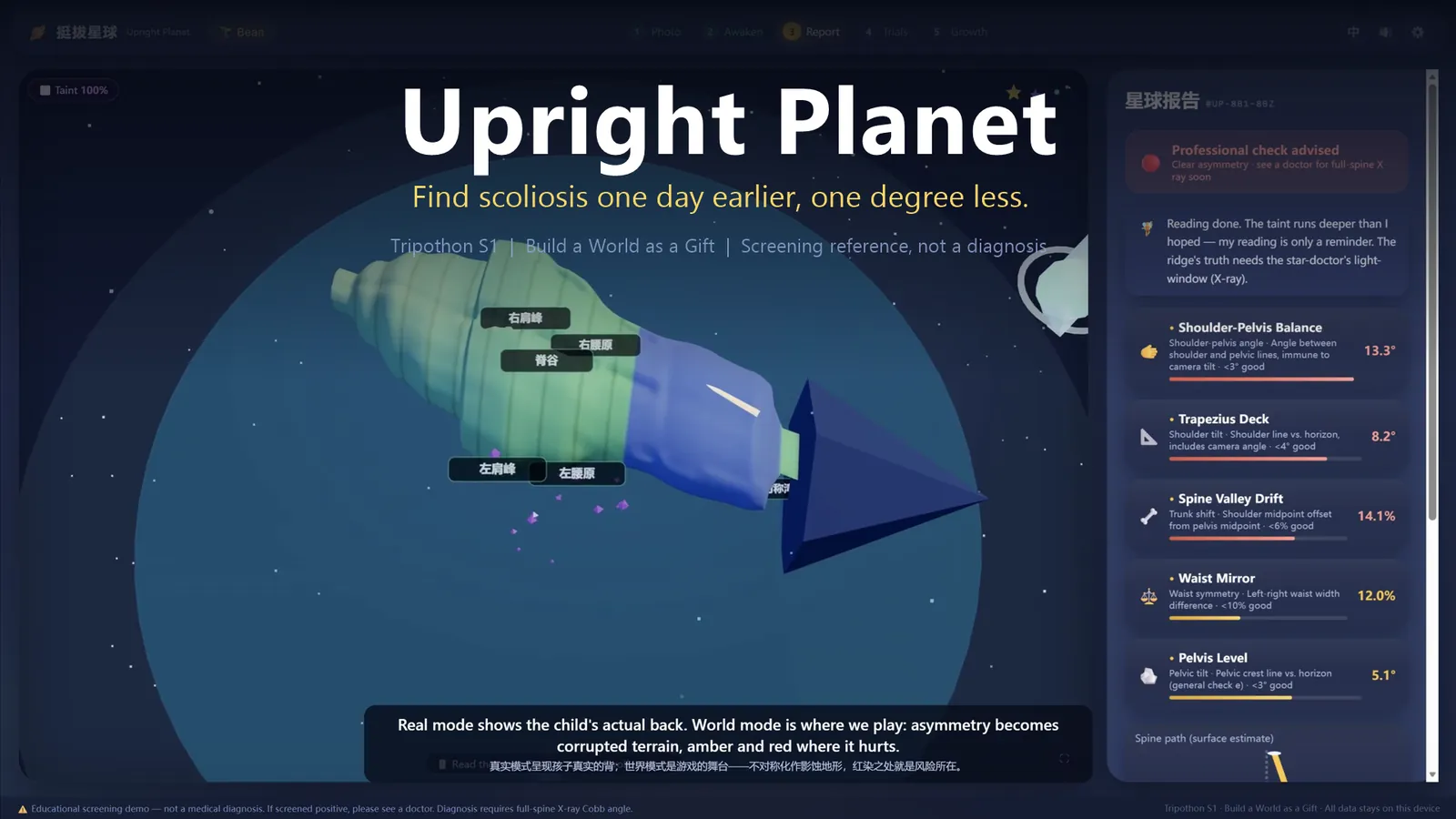
Take a photo of the child's back (side and forward-bend views are optional). MediaPipe locates landmarks on the body and computes five symmetry metrics: shoulder balance, shoulder-pelvis relative angle, trunk lateral shift, waist-contour symmetry and pelvic tilt. The result is sorted into green, yellow or red tiers following the screening approach of China's national standard GB/T 16133. Meanwhile, Tripo turns the same photo into a 3D model of the child's own back in about 40 seconds, with doctor-style measurement lines (shoulder, pelvis and midline) drawn right on it, so any asymmetry is easy to see.
In World mode, the back becomes a planet. Asymmetry shows up as shadow-eclipsed terrain, which the child restores through three camera-based motion trials, and the planet's guardian creatures were generated with Tripo text-to-3D. In the end, the planet stands upright again and the red zones recede into oases. It is a gift for every child who hides their back from their parents.
The app is clear throughout that it offers screening, not diagnosis, and the only advice it ever gives for the red tier is to see a doctor for a full-spine X-ray. Because 2D landmarks can't measure the spine's axial rotation, forward-bend photos always land in a conservative tier: the app would rather withhold a green than offer false reassurance. A high-risk questionnaire also tightens the tiers automatically.
Under the hood, it is a zero-build static site with Three.js and MediaPipe running fully locally, so it works offline, and it comes in web and Android versions. With Jupiter's glasses-free 3D rendering, the planet shows real depth on a lenticular 3D screen.
How Tripo was used
Tripo is at the core of the work, in two ways:
- Image-to-3D back reconstruction: from one photo of a child's back, the app calls Tripo API image-to-3D to generate a PBR 3D model of the child's own back in about 40 seconds. The model isn't a display piece but the basis for screening: shoulder, pelvis and midlines are overlaid right on it, making asymmetry plain to see. A same-origin proxy gets around the browser's CORS limits on the API, so a purely static site can run the whole workflow.
- Text-to-3D creatures: the four guardian creatures, Jimao, Yiniao, Xingshu and Xiaoji, were generated with Tripo text-to-3D and bundled into the work; their field-guide cards show the original prompts.
All of these models are displayed through Jupiter's glasses-free 3D rendering pipeline.