

 Download app
Description
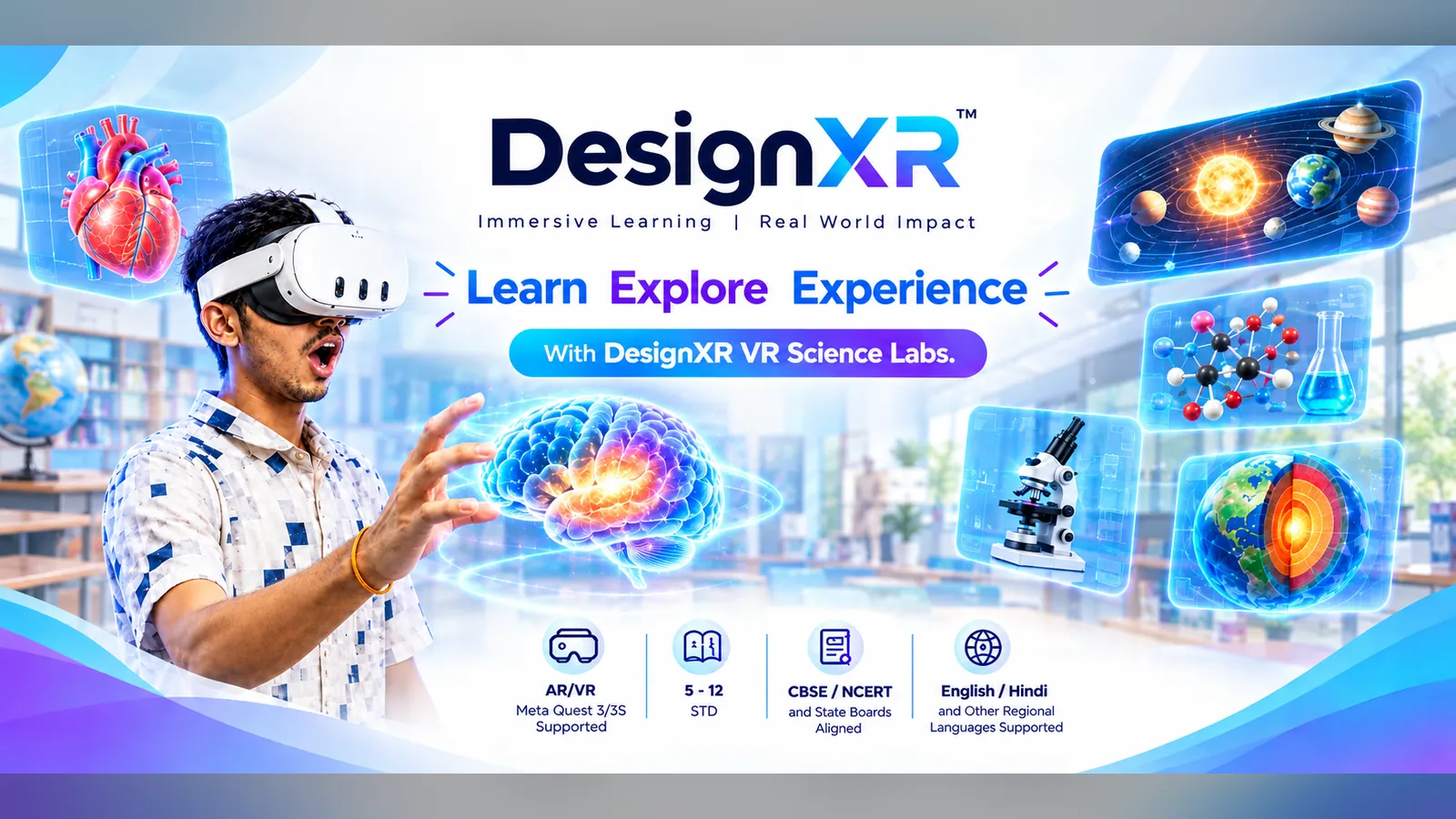
What if students could stop reading about science and actually step inside it? DesignXR: Science Beyond Textbooks is a VR learning experience that turns difficult, abstract science concepts into worlds students can see, explore and interact with.
In a traditional classroom, a student might learn about the human heart from a diagram, study the solar system on a page or memorize the structure of an atom from a textbook. DesignXR turns these concepts into 3D experiences: students can explore the human body, travel through the solar system, investigate cells, understand atoms and matter, observe magnetic fields and more, not as spectators but from inside the lesson. The experience follows a simple journey: read, explore, interact, understand, remember.
The goal is not to replace teachers or textbooks, but to give teachers another way to explain concepts that are hard to visualize in a conventional classroom, and to let students learn through curiosity and exploration. The team believes students should not only be told how something works; they should be able to experience it. DesignXR is a gift for every curious student who asks "Why?", "How?" and "What does it actually look like?", for the team's younger selves and for children around the world.
The project is designed for standalone VR on Meta Quest 3 and 3S, with Unity as the interactive engine and Blender-based 3D workflows used to build the scientific environments and models. Voiceovers were made with ElevenLabs, with ChatGPT and Gemini used for the voiceover scripts and image generation. The DesignXR concept, some 3D educational content, audio and the Unity project structure existed before the event; during the hackathon the team built the submitted experience on that foundation and added PICO support, including new XR implementation and configuration, platform adaptation, interaction improvements, content integration, testing and optimization.
How Tripo was used
Tripo was part of the project's 3D asset workflow. Its main contribution was speeding up the 3D content pipeline and making it easier to prepare assets suited to an interactive XR environment, complementing the Unity-based workflow rather than replacing the overall development process.