


 Try it live
Description
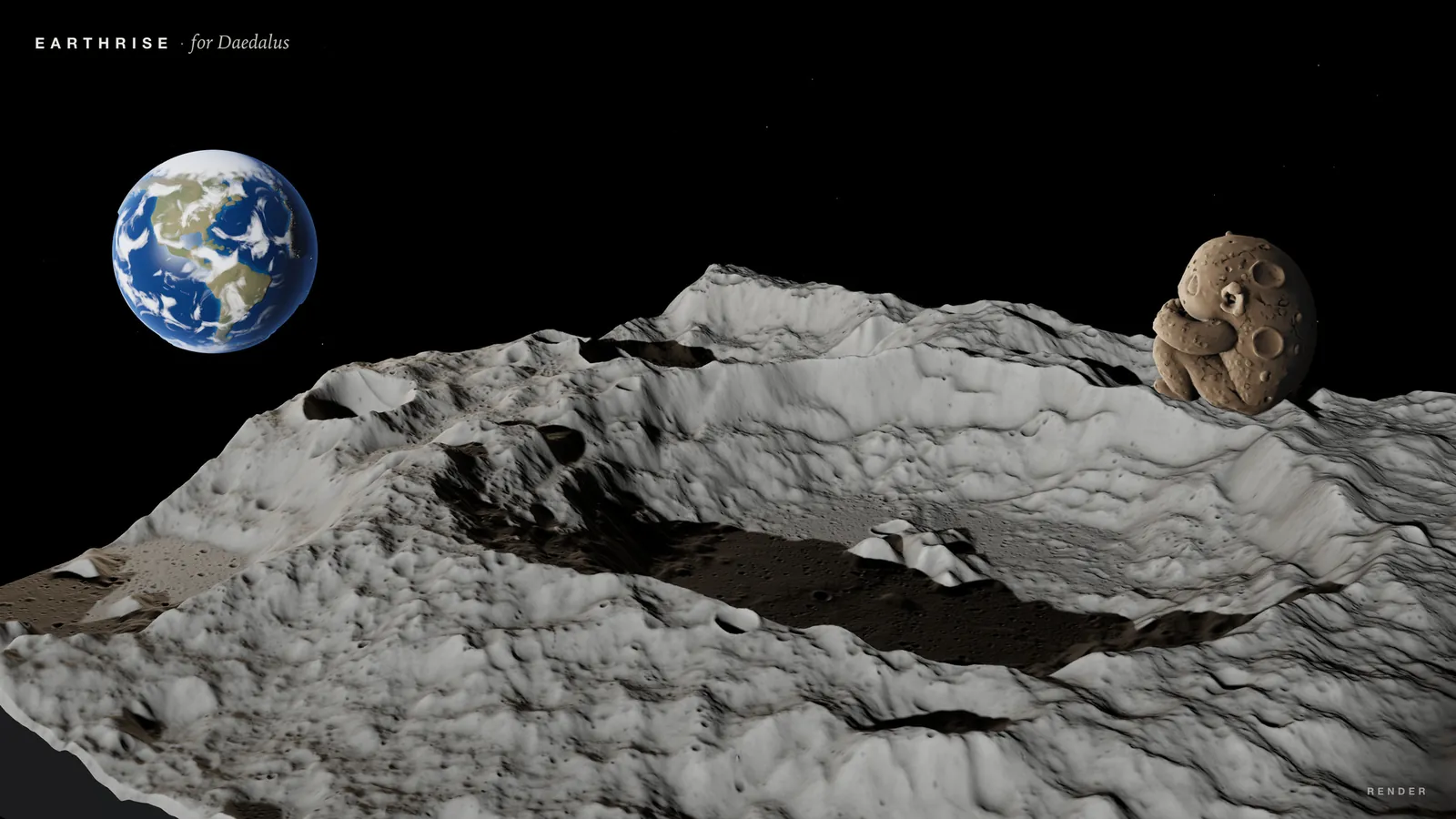
EARTHRISE is a gift for Daedalus, a crater that has never once seen Earth. It lies near the middle of the Moon's far side. Because the Moon keeps one face toward us, Earth is always on the other side as seen from Daedalus. We have photographed Daedalus from orbit, but it has never once seen us. The far side isn't dark; it gets as much sunlight as the side we see. What it never gets is Earth.
What hides Earth also makes it quiet. Radio astronomers call the lunar far side the only truly radio-quiet zone in the inner solar system, and one proposal puts a radio lab inside Daedalus, the crater most shielded from Earth's noise. It wants quiet, so the team didn't send it a signal. They sent it a light.
The world is 180 × 150 km of the real far side around Daedalus, built from elevation data measured from lunar orbit (SLDEM2015, NASA and JAXA) and set out as a desk-sized model: 1 mm = 1 km, with heights exaggerated ×3. A small Earth waits, hidden, behind the far rim, and a tiny watcher sits on the near rim.
Drag the crank, or press "Turn it for me". A dawn glow lights the far ridge, then Earth climbs over the horizon, brightening as more of it clears the real terrain. The first time it peeks over, the camera flies to the watcher's eye so you see it rise the way Daedalus would, and a counter tells you which earthrise was yours. On wide screens, the camera then circles around to the watcher gazing at its first Earth; "Sit on the rim" takes you back to its eye.
There is nothing to install and no third-party requests, with layouts for desktop and mobile. The terrain, the arm's motion and every placement come from the CAD and mesh files made for printing, and a GPU visibility test confirms that Earth is fully hidden at rest from 64 viewpoints, including the watcher's eye. The fairy-tale scale is deliberate. At the model's true scale, Earth would be a 12.74 m ball hanging 384.4 m away; the team broke scale for only two things, someone to look and something to see. All sound was synthesized by the team, the voice-over is AI (VoxCPM2 cloning a Qwen3-TTS voice), and Claude Code served as a coding assistant.
How Tripo was used
Tripo generated the gift itself: the small lit Earth and the watcher who waits for it.
- Generation: Tripo text-to-3D (model v3.1-20260211), 3 prompts per character and 6 tasks in total, about 3.7 minutes each. The author kept the Earth candidate with the top script score and picked the watcher by eye.
- Made into parts: the author's scripts turn both models into printable parts. The Earth becomes a 1.8 mm hollow shell with a hidden LED socket; the watcher turns 20° to face it and is draped onto the real terrain.
- On the web: the browser repaints that Earth by day and night.