

 Try it live
Description
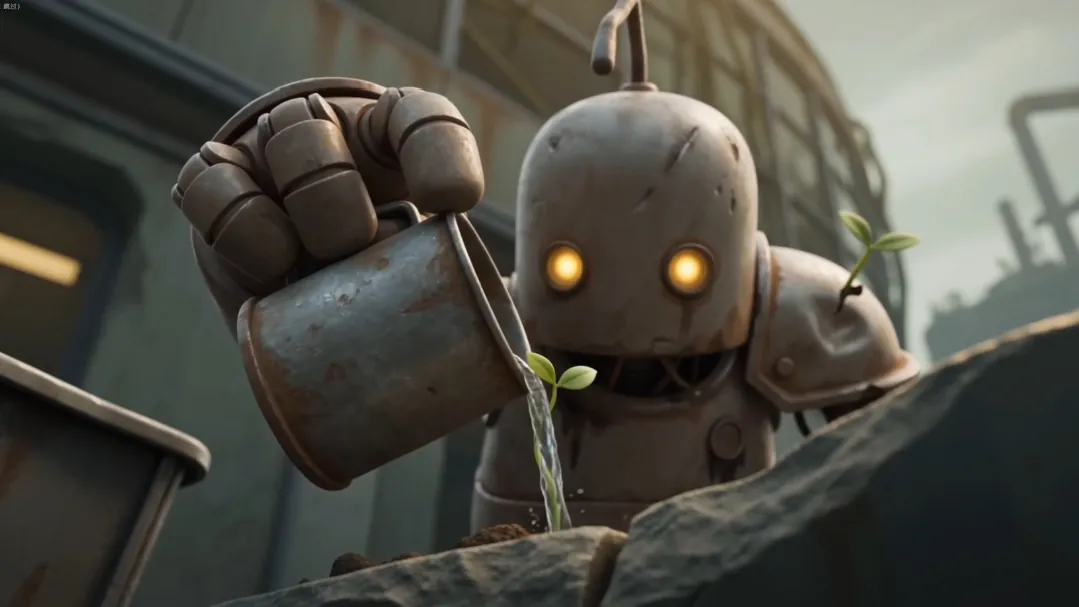
The Last Caretaker is a three-level browser game about two robots working together in an abandoned ecological station. You control Ashou (G-01), an old maintenance robot, and Yaya (E-02), a newly awakened one.
The core mechanic is passing abilities on. Ashou teaches Yaya skills like jumping and carrying objects, but every time he does, he permanently loses that ability himself. You switch between the two robots to solve puzzles, move objects and collect fragments, and in the end open the final door together. At first Ashou leads the way and solves the problems; as the game goes on he can do less and less, while Yaya grows more capable and starts helping him in return. Their relationship shifts from a senior teaching a newcomer to two robots looking after each other.
The author made the game as a gift for "the person who replaces me." To the author, being replaced does not always mean losing your value. It can also be a handover: one person leaves behind their experience and abilities, and someone else carries on from there. That is why "teaching means losing" became the core mechanic.
"The person who replaces me" sounds like a story about leaving, but the author chose to see it as something continuing. The game is not really about who replaces whom; it is about what gets passed on. Being learned, remembered and inherited is another way to exist. In the author's words: "If someone replaces me one day, I hope what I leave behind is not just a position, but something that can still be used and remembered." The game is built with Three.js.
How Tripo was used
Tripo is the core production tool for every 3D asset in the game: all of the models were generated with Tripo.
- Two tiers of models: Tripo H3.1 for the high-detail models and Tripo P2.0 for some of the low-poly ones.
- A batch pipeline: Nano Banana generated reference images, then Qwen turned the game's needs into modeling instructions and called the Tripo API to generate the models, rigs and animations in batches.
- One consistent style: compared with making each model by hand, this pipeline brought Tripo directly into batch production of the game's assets, speeding up the work and keeping the overall style consistent.