

Description
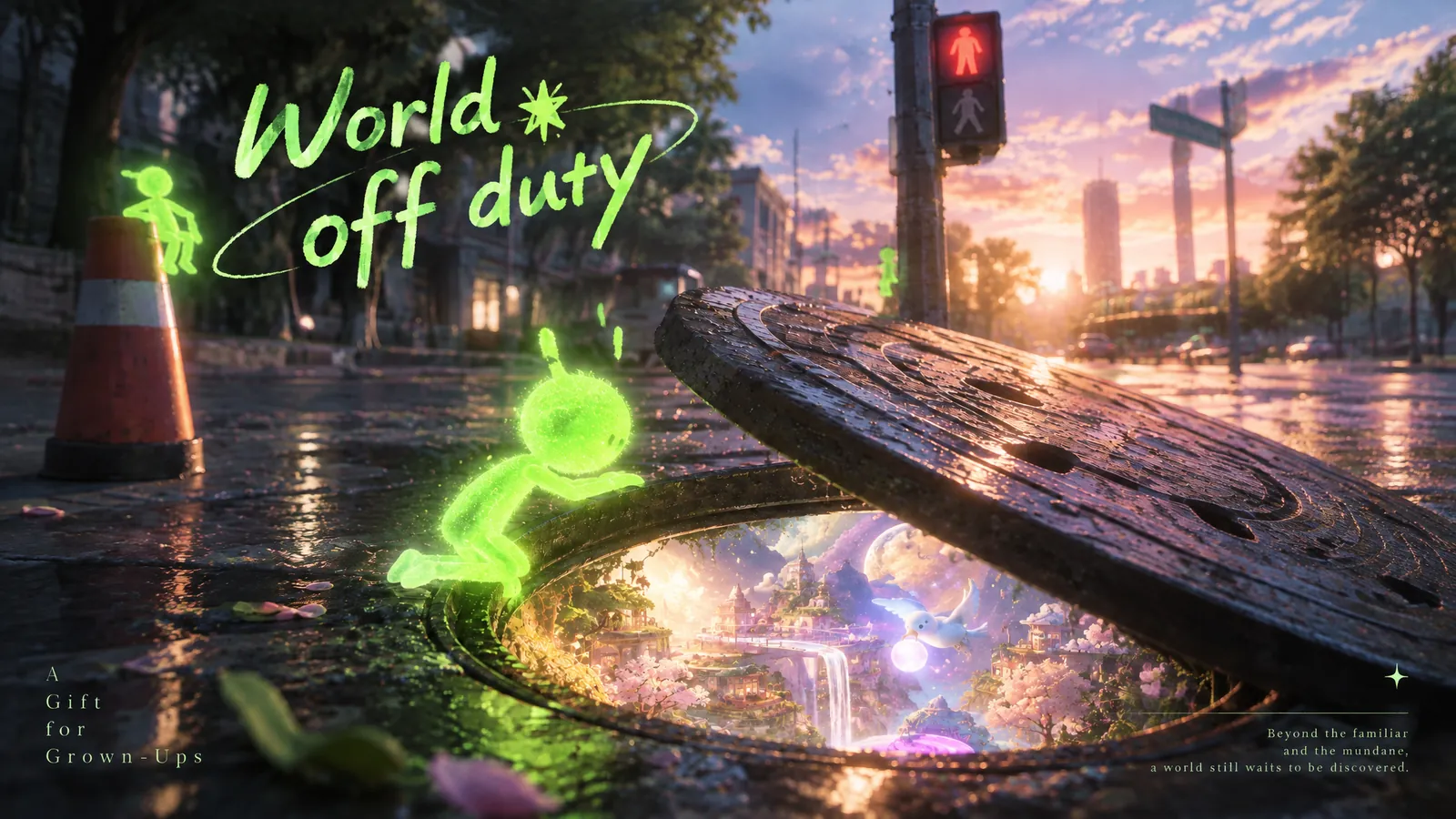
World Off Duty is meant for grown-ups who have settled into routine and slowly lost their sense of wonder, offering them a chance to see the world anew. As kids we could happily play all day anywhere; as adults we rarely feel the joy of exploring and discovering. In the film, someone accidentally falls into the world behind reality, and everyday things come back to life, full of imagination. The author did not set out to make an epic fantasy adventure, only to quietly open a crack beyond the real, familiar everyday, so we can feel again that the world has not become boring; we have just grown numb.
After many rounds of testing, the author combined AI-generated 360° environments and Gaussian splats, AI-generated models and AI video with a traditional CG pipeline. Instead of the endless rerolls of purely AI video models such as sd, this workflow greatly improves efficiency without giving up control over the image. Once the content of each scene was worked out, GPT wrote the image prompts, the best images were turned into assets with Tripo, and other assets were sourced to build the sets. The office and city scenes, with their complex camera moves and interactions, were rendered offline with a traditional CG animation pipeline to guarantee quality. The later basement, kingdom of traffic-light figures and underworld started as prompt-generated 360° panoramas, which Marble turned into Gaussian splats of entire scenes, then brought into Cinema 4D and composited with the hero objects. The environments are AI-generated, the core elements in frame are handmade and the camera is fully controllable, which cut the cost of building environments and rendering dramatically.
Marble's splats can be rendered in Octane. Since splats cannot yet take part in global path tracing, the author renders the splats directly and uses the collision mesh Marble provides to receive global illumination, compositing it in passes, so the ground and walls of a generated scene can catch shadows and reflect other objects just like polygon geometry. In the past, a low-angle shot could get by with a sky HDR, but any visible ground had to be built by hand; now Marble delivers the whole environment.
Apart from the transitions, the film uses no AI video generation: every scene is real 3D data, leaving room to bring it into UE or web interaction later. Offline rendering ran on Octane network render nodes, with four 4090 GPUs across the workstation and a server previewing and rendering at once; in the gaps between frames, the server also ran video and sound generation in ComfyUI (minimaxh3, Stable Audio) to keep the GPUs busy. Finally, the Cinema 4D renders were composited in After Effects, with transitions between scenes generated by a video model; image generation also used qwenimage2.1.
How Tripo was used
Tripo is where the film's moving elements come from.
- Everything that moves: every moving object in the film was generated with Tripo, then combined with the author's earlier handmade assets and purchased assets.
- From images to assets: for each scene, GPT wrote the image prompts, and the best resulting images were turned into assets with Tripo.