

 Download
Description
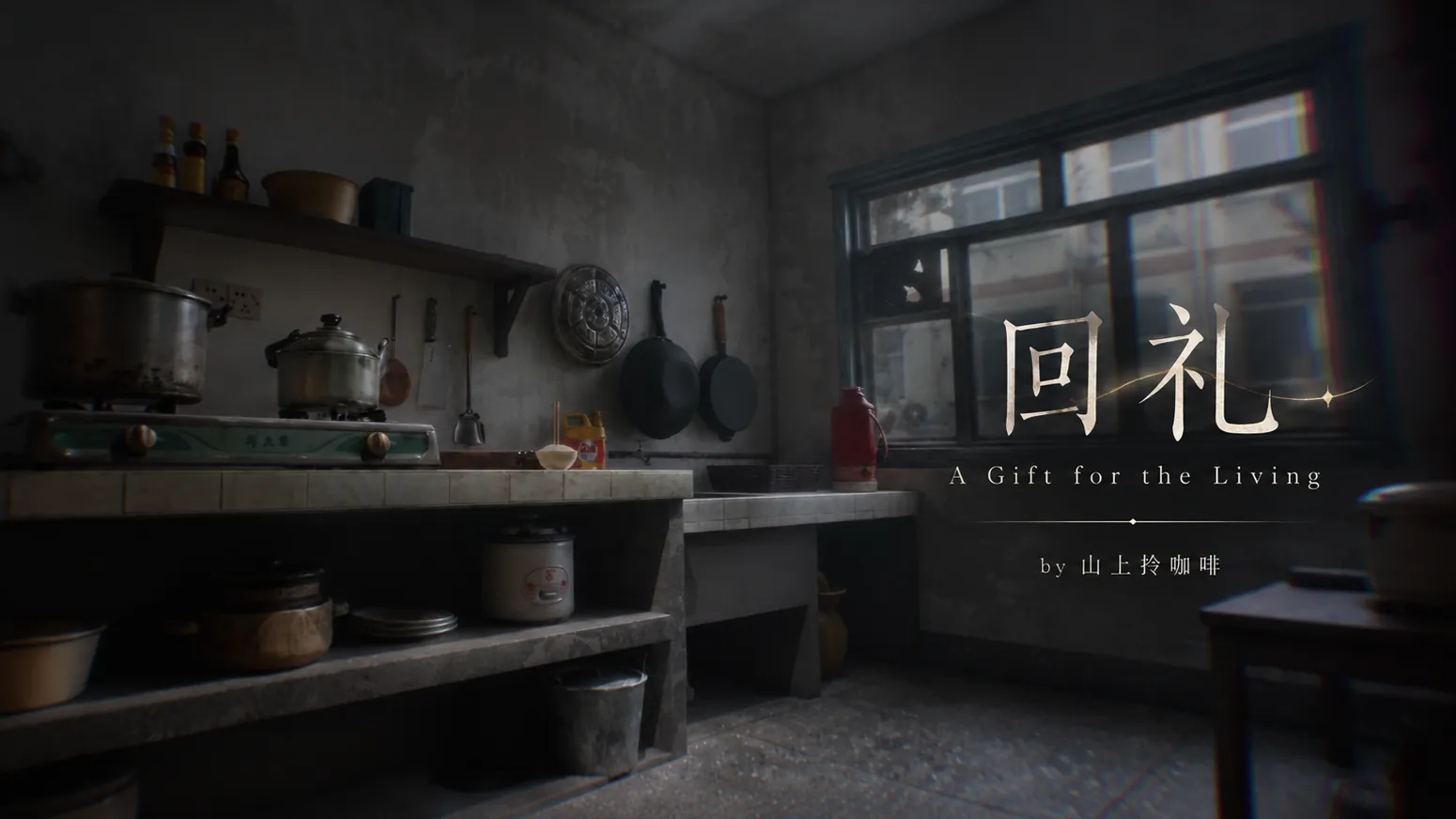
In Return: A Gift for the Living is a first-person narrative game rooted in Chinese family life, and a gift for those who live on, remembering. Drawing on the childhoods of a generation born around the turn of the millennium, it invites players to recognize their own childhood and family in a familiar old home.
Story and art carry the feel of that time together: old furniture, paper workbooks, a toy race car, a sewing box, and a phone a mother keeps using long after her child replaces it. The look, use and wear of these objects show the passing of time, while players build a toy ramp, do homework, set the table and sort through keepsakes, taking part in the family's daily life with their own hands.
A childhood dream gives way to an adult homecoming. Following sounds and rediscovering belongings, the player searches for their mother and comes to understand her anew, only to discover that it is they who have died. She is mourning them. In the finale, the player moves their childhood toy car once more so she can sense their presence. An act of play becomes an act of love.
Character dialogue was voiced with Fish Audio, some everyday sound effects were generated with Fish Audio, Stable Audio 3 and Adobe Firefly, and the music was generated with Suno, then selected, edited and mixed into the game by the team.
Through one family's story, the team hopes to evoke a generation's shared memories. This gift is a child's answer to a grieving mother, and a reminder to players to cherish the everyday time they still have together and to express their love while they still can.
How Tripo was used
Much of the art in In Return was generated with Tripo or made with its help. The team's approach is to let people and AI each do what they do best, and Tripo greatly sped up production. The game even hides an easter-egg level that displays every model the team generated with Tripo.
- Main pipeline: reference images are gathered by hand, GPT distills the requirements for each asset, Codex batch-processes the three-view sheets, Tripo generates the assets, and the Tripo Bridge plugin brings them into Unreal Engine.
- Other approaches: modeling by hand and texturing with Tripo (the doors); generating a model with Tripo, iterating on three-view renders with GPT, then returning to Tripo for the final asset; generating parts separately and assembling them into one object (some of the boxes); and refining generated models by hand for more precision (the sofa).
- Style checks: once the graybox was in place early on, Tripo let the team validate the art direction and style fit far faster than a traditional pipeline.
- A few assets were refined further with traditional PBR tools such as Blender and Substance Painter.