

 Download source
Description
Sunken Palace is an atmospheric puzzle exploration game with no combat and no enemies. In the year 4626, you are a ruins surveyor from the future. On a routine underground survey, you detect an unknown man-made structure of unusual scale and are sent down to document the site.
The whole ancient complex lies under groundwater, and the water level is the key to the space. Raise or lower it, and bridge decks, stone steps and corridors emerge or disappear. As the water rises and falls, the same space switches between walkable paths and underwater areas you swim through, completely rewriting what you can see and where you can go.
The game follows a core loop of observe, scan, understand, act, change the space and observe again. You scan remnants, read the forms of the buildings and switch back and forth between two views: underwater, you glimpse the outlines of the architecture; on dry land, you check the structure in person. Piece by piece, you work out the true identity of the sunken site, until you realize that the ruins buried deep underground are the ancient Jinci Temple. Gather the complete site data, finish your record and find your way back up. With combat and complex survival mechanics stripped out, the game focuses on exploring architecture through pure observation and deduction. It is the author's gift to their idol.
During production, the team used Tripo to turn the level zones and the high and low water levels in the design document into 3D scenes, walked through them in first person on a PICO headset to check sightlines and the scale of the paths, and resin-printed a miniature level diorama with swappable water-level layers on a HeyGears printer to work out how players would move. The game is provided as Unreal Engine 5.8 project source code and needs to be built locally.
How Tripo was used
Tripo turned the words in the design document into 3D level prototypes the team could step into and test.
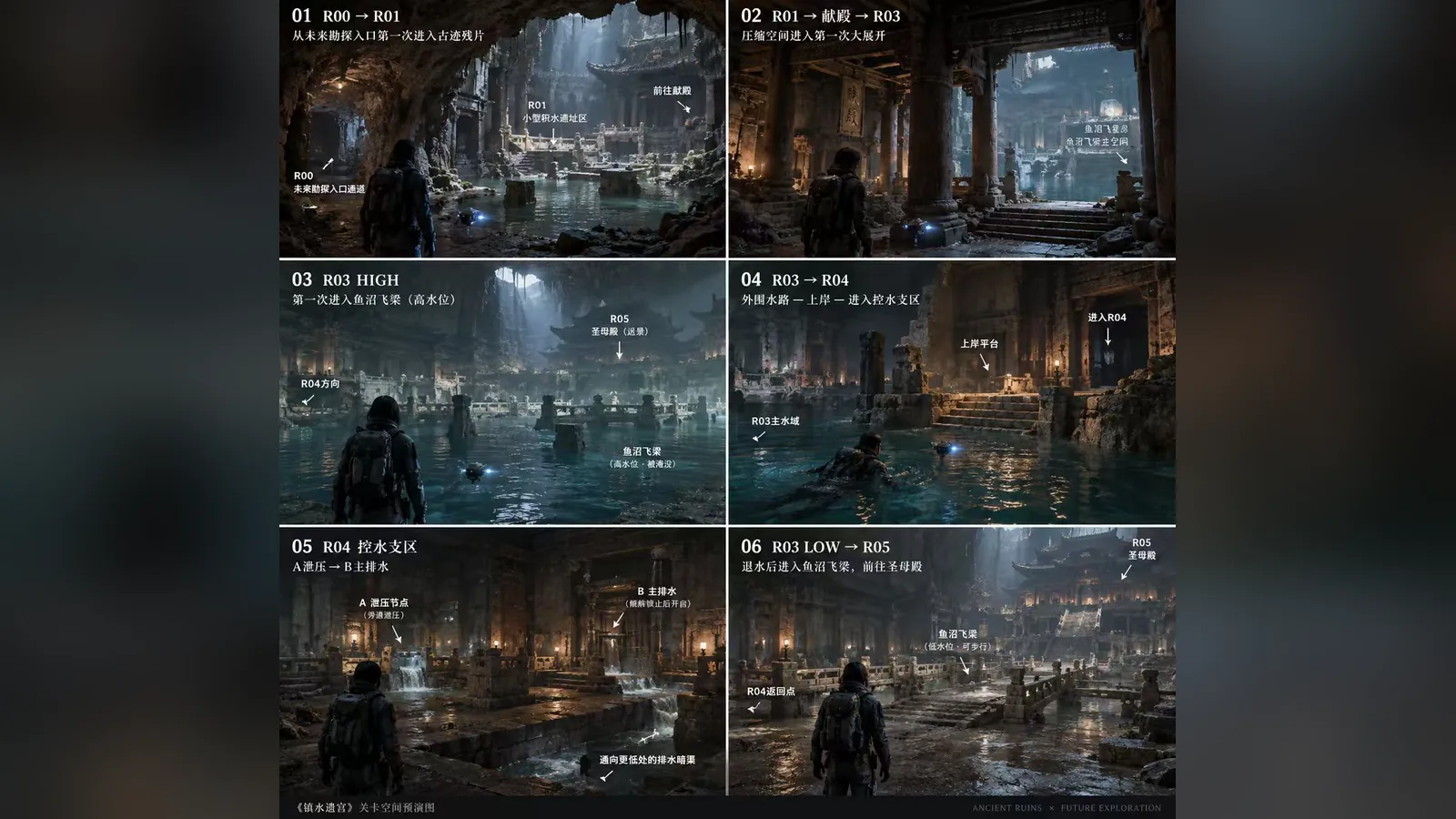
- From text to space: following the level zones, water-level rules and three-stage learning goals in the core design document, Tripo turned written descriptions such as "the small flooded passage", "the full Fish Pond Flying Bridge space" and "the water-control wing" directly into 3D spaces.
- Two water levels: Tripo generated high-water and low-water versions of the same level, with basic renders. With a composition tool, the team then unified the camera framing and marked zone numbers, functional areas, directions of travel and water-level points, so it is easy to see how routes change with the water.
- Feeding back into design: comparing the two water levels quickly showed whether the paths made sense, whether the pacing flowed and whether players would naturally pick up the three-stage learning goals; the findings went back into the design document, closing the loop from written design to 3D build, testing and refinement.
- Into VR and the physical world: the two water-level scenes were also brought into PICO for first-person VR walkthroughs, and split up and printed with HeyGears as a physical diorama. The first checks scale by feel; the second maps out the overall routes.