

 Download source
Description
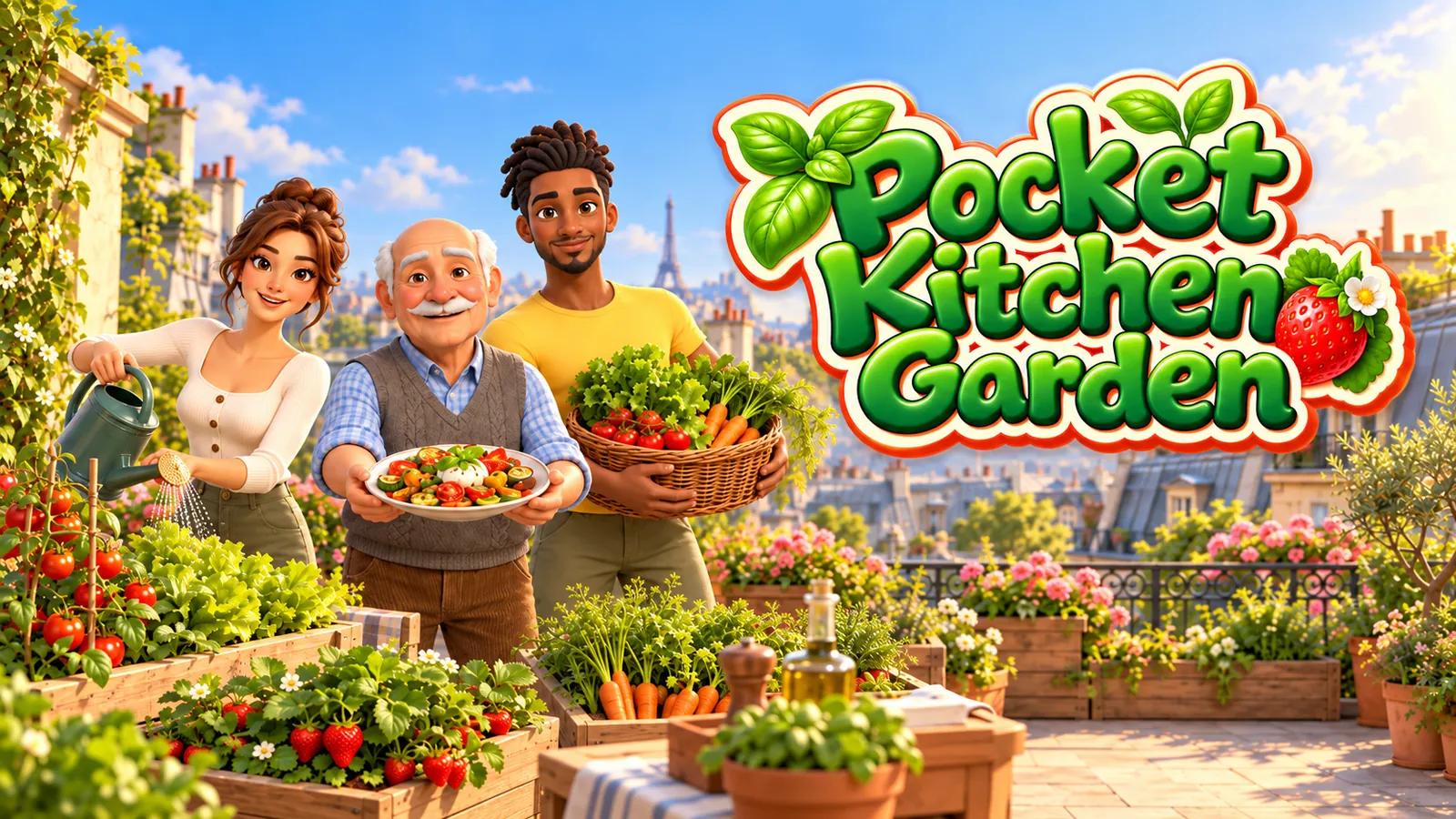
Pocket Kitchen Garden (Potager de Poche) is a balcony vegetable garden for those who have none. The world is a Parisian apartment building with three balconies, belonging to Léa, Marcel and Jimy. Each has their own apartment, music, phone and way of living, and they don't wait for you: they look out of the window, work out, dance, take a nap, and follow with their eyes whatever passes by in the sky.
Pick a seed, sow it, water it and watch it grow. There are 25 plants, each with real 3D models for seven growth stages, generated with Tripo. As you sow, you already see the vegetable you will harvest, so you learn to recognize it. Once ripe, it goes into your basket. Every day the phone suggests a different recipe, and you have to gather its ingredients. When one is missing, trade vegetables with the neighbors at the market, or buy seeds at the shop with points earned by cooking; points also buy more pots. Then cook and offer the dish to a neighbor, who one day gives one back. There are 66 recipes to discover, a notebook to keep the ones you have made, a leaderboard of the best gardeners, cooks and traders, and a mini-game inside the in-game phone.
What you feel is calm, first of all: the game runs at the pace of the plants, and you come back to see whether they have grown. Then pride, when the first dish comes out of the kitchen. And generosity, because in this building you cook to give, and the neighbors give back. It is a gift for everyone who has never grown a vegetable, children and adults alike.
It is the author's first game, and everything was made by the author alone: Tripo for the 3D, Blender and Mixamo for assembly and animation, furniture and Paris sets generated by Codex with Blender scripts, illustrations of dishes, vegetables and the sky from ChatGPT, music from Gemini, and code written with the help of Claude and GPT Astra 6 via Codex. The project started from scratch during the event on September 26, 2026; nothing existed before. The game runs in the browser on computers and phones. It is provided as source code, built with Three.js, Vite and Supabase, and needs to be built locally to run.
How Tripo was used
Tripo made the game's three characters and all 25 plants.
- Three characters: generated with Tripo and rigged on a single Mixamo skeleton that carries all the animations, shared by the three bodies (one body per file, animations made once).
- 25 plants: generated in batches through Codex and the Tripo plugin from sheets of seven vegetables × seven growth stages. A careful pass on cherry tomatoes produced seven lovely stages, and the author plans to redo the others the same way.
- The pipeline: Tripo, then Blender with a cut-and-export script, then Mixamo, then Three.js.