

 Try it live
Description
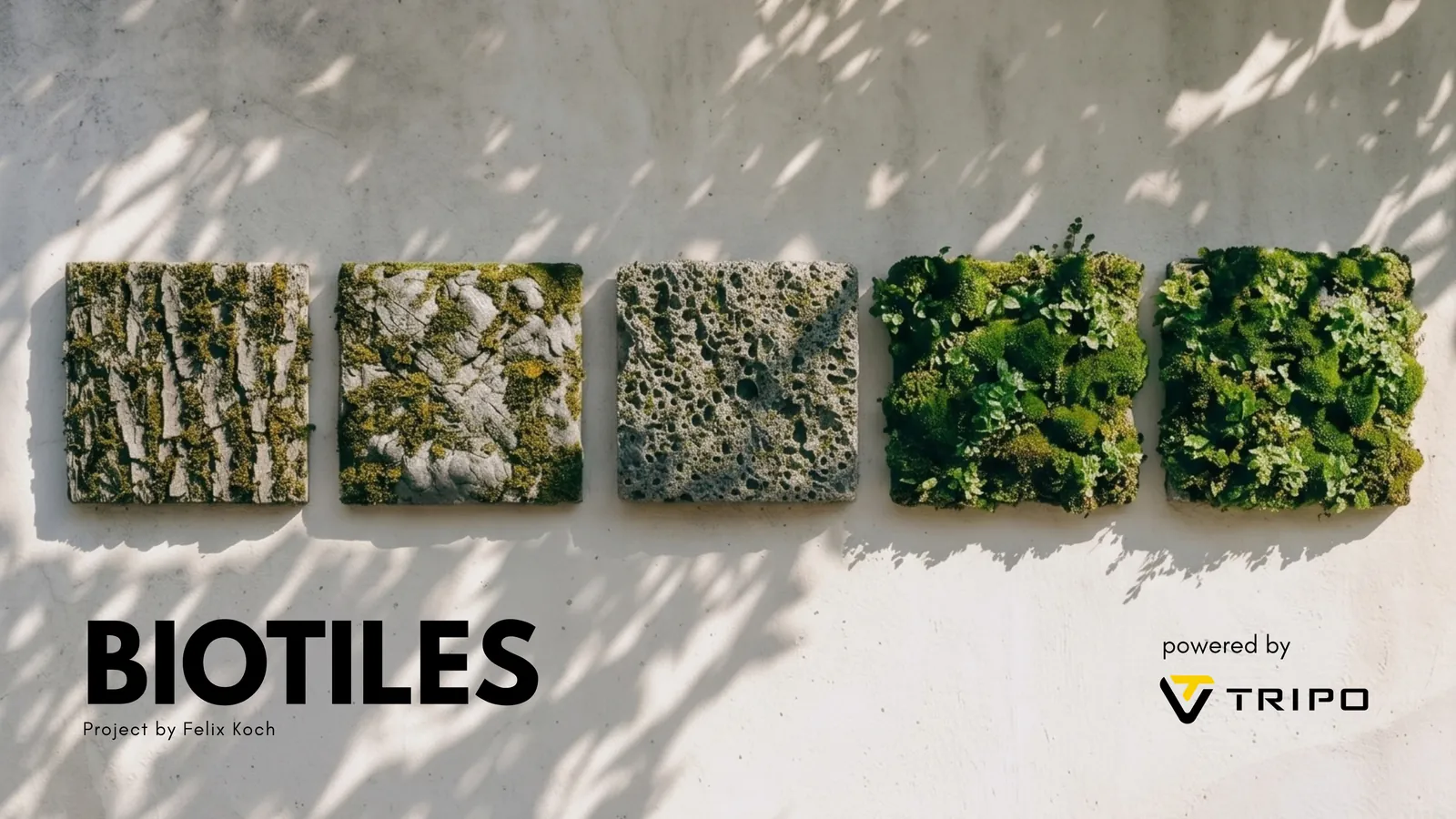
Cities are built from smooth, dry surfaces that nothing can hold on to. Nature works differently: furrows in bark, rain grooves in limestone and honeycomb hollows in sandstone hold water, give shade and become home to moss, lichen and small creatures. BIOTILE brings these surfaces into the city.
How it works:
- Capture: photograph a living surface on a walk, and Tripo turns the photo into a 3D model.
- Generate: BIOTILE turns the model into a seamless relief that can repeat across a wall, adding small hollows for moss and fine grooves that guide rainwater downward. Out comes a ready-to-print tool set: a mold (or stamp), a casting frame and a back plate with slanted hanging holes.
- Cast: print it, cast tiles in concrete or clay, and hang them up. For Barcelona, there is a hexagonal mode inspired by Gaudí's paving tiles.
Every tile gets a code and can be registered on a public map, where anyone, a school class for example, can add photos over time and record what grows: a small citizen-science archive of the city's living walls. Smooth control tiles help compare how much the relief really helps.
The gift is for urban life: the moss, insects and other small creatures that are short of homes in the city. It is also a gift for people, a journey from a walk in nature to an object in your hand, and then to a wall you can watch come alive over the months. BIOTILE is a working web app and prototype, released as open source: code under MIT, designs under CC BY-SA and data under CC BY.
How Tripo was used
Tripo is the core of BIOTILE.
- Photo to 3D: from a single phone photo of bark or stone, Tripo's image-to-model API (v3.1) creates real 3D geometry. It takes the place of photogrammetry, 3D scanners and hand sculpting, so anyone, even a school class, can capture a living surface.
- From mesh to tile: the mesh becomes a height field, is made seamless and gets moss hollows and water grooves, ending up as print-ready casting tools and, finally, a real tile on a city wall.