

 Try it live
Description
Not long ago, you had to master model editing, texturing, UV unwrapping, retopology, rigging and skeletal animation before you could call yourself a qualified modeler, and mastering Blender alone took a lot of time. ChatSpace is a gift for 3D modelers. The author believes that with advances in LLMs, NeRF, Gaussian splatting and agent infrastructure, modelers now have a chance at new tools, without first learning complex software like Blender, 3ds Max or C4D.
The idea: abstract every AI capability that helps with 3D modeling, plus everything Blender itself can do, into tools an AI can call, so all of the work can be done in natural language. Complex jobs that used to take many rounds inside modeling software, such as modeling, texturing, UV unwrapping, retopology, baking, rigging, skeletal animation and even CAD drawing, can be done in a single exchange. It all happens in one chat box and can run in parallel and in batches, so you can edit many models at once.
For example, upload a photo of a scene: the AI works out what is in it, generates reference images and 3D models for each element in batches, and places the models where they belong, ready for further edits. There is also a first-person mode with hand tracking: grab and select a model in the scene with your hand, then say or type what you want, from modeling and retopology to UV unwrapping and animation. The interaction is designed with XR in mind.
AI modeling is already fast. What happens when ten AIs are modeling for you in batches at once? The author thinks it is more than a tenfold gain in efficiency.
How Tripo was used
The author turned every capability in the Tripo API docs into a tool the agent can call, including model generation, reference image generation, texture editing, part segmentation, mesh completion, retopology, rigging and animation.
- Photo to scene: a user uploads a photo of a scene, the AI works out which elements it contains, and Tripo generates reference images and then 3D models for each element in batches, which are placed where they belong. The user can keep editing with Tripo's other capabilities.
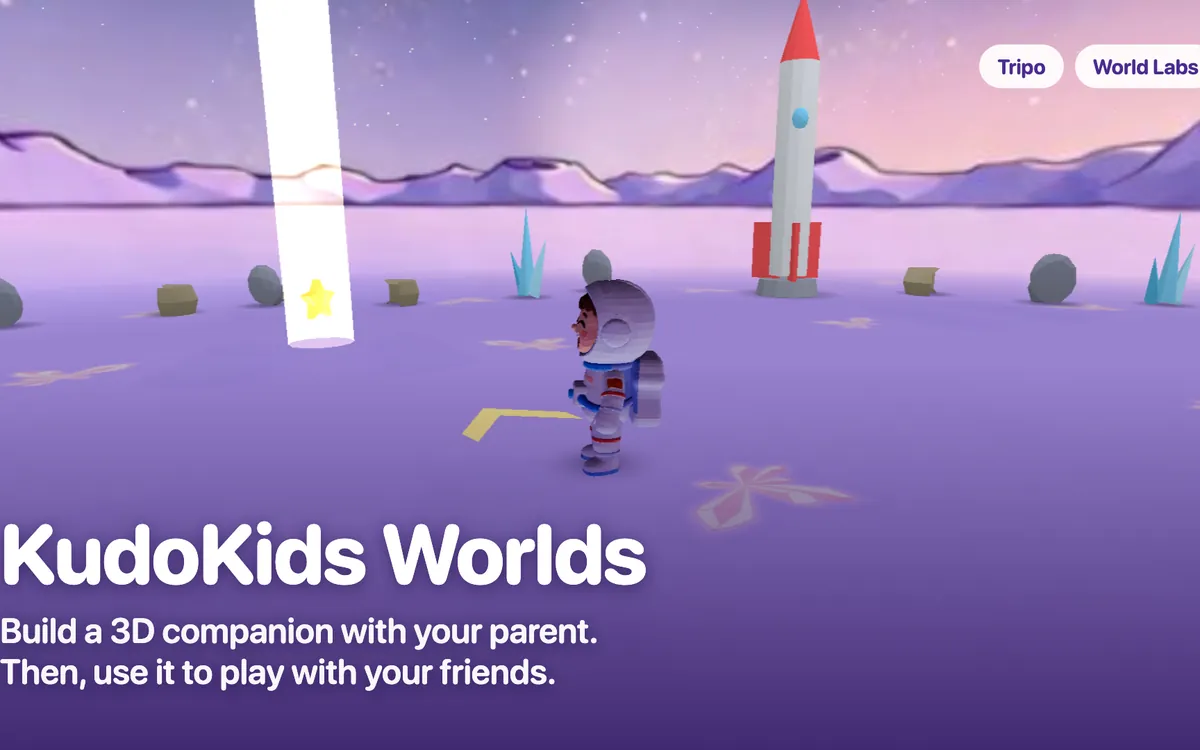
- Working with World Labs: elements inside a World Labs scene can't be interacted with on their own, so the author built an agent workflow. An image model removes the objects from the photo to get a clean reference of the setting, World Labs generates the environment from it, Tripo generates the removed objects as 3D models in batches, and colliders and interaction logic are added, resulting in an interactive 3D scene.